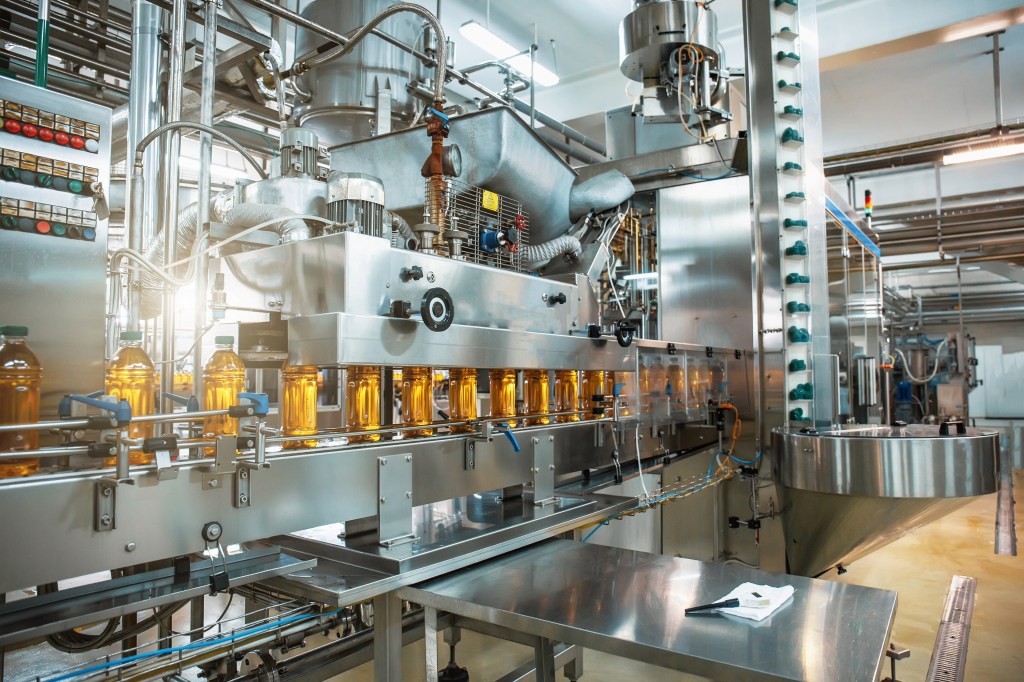

Induction heating is an innovative technology with the potential to significantly enhance energy efficiency and reduce environmental impact in thermal processing. This post provide information on how induction heating works, its wide-ranging industrial applications, and the benefits it offers.
The use of induction heating in the food industry is a green innovation that saves resources and improves productivity and efficiency.
Understanding Induction Heating
When processing liquid food products—such as sauces, broths, or beverages—conventional systems typically employ tube-in-tube or plate heat exchangers, powered by steam from fuel-fired boilers. However, these legacy systems (steam operated pasteurizers) generally operate at only 20 to 40% thermal efficiency.
Imagine an alternative heating method that transmits up to 95% of energy directly to the product, offering a more sustainable and efficient approach (Habibov, 2023 and Campden BRI, 2023).
Induction heating is an emerging technology with strong potential to lower emissions—particularly when powered by renewable electricity sources. Much like domestic kitchen induction hobs, which use an electrically energized coil to heat a metal pan that in turn heats the food, industrial induction systems apply the same principle on a larger scale and a different configuration.
In industrial applications, the induction coil is wound around a pipe through which liquid flows. This coil generates an electromagnetic field that heats a metal heating applicator (a metal element placed at the core of a processing pipe). The applicator transfers heat directly to the liquid and also serves as a mixing element to promote uniform temperature distribution. In other words, this applicator transfers heat to the surrounding liquid, allowing for ‘inside-out’ heating. Its design may include an expanded surface area to enhance heat transfer efficiency, ensuring consistent and controlled thermal processing.
Beyond serving as a heat source, the applicator also functions as a mixing element, promoting uniform temperature distribution throughout the fluid. Its design can incorporate an increased surface area to enhance heat transfer efficiency, ensuring consistent and effective thermal processing.
This precise and localized method enables equivalent thermal treatment to conventional heat exchangers, but at lower thermal loads and with several additional advantages—ultimately leading to improved product quality (Campden BRI, 2023).
Enhanced heating efficiency can decrease startup durations and allow for a shorter heating zone, helping to minimize waste during startup or when restarting after interruptions. The rapid response of electric systems enables more precise temperature control, potentially allowing manufacturers to lower their target temperatures—something not as easily achieved with slower-reacting steam-based systems.
Applications of Induction Heating in Food and Beverage Processing
Induction heating is an electromagnetic heating technology that has several advantages such as high safety, scalability, and high energy efficiency. Induction heating is highly versatile and can be applied across various thermal processing steps in the food and drink sector, including: Ultra-high temperature (UHT) milk and other products, hot fill, or high-temperature-short-time (HTST) pasteurisation of liquids such as beverages, oils, bases, stocks, and sauces. It is also recommended for implementation in the production of concentrated food products like condensed milk and tomato paste and other thermal technological processes like pasteurization of liquid whole eggs. Its ability to deliver rapid and accurate temperature control ensures effective microbial inactivation while preserving the nutritional value and taste of foods better than traditional methods.
Advantages of Induction Heating Over Other Novel Food Processing Technologies
When evaluating the use of PEF processing for food preservation and treatment, several key characteristics of the food must be taken into account. One critical factor is the food’s electrical conductivity, as it influences how effectively electric fields can penetrate the food structure (Alkanan et al, 2024). Generally, foods with higher water content are better suited for PEF processing due to their enhanced ability to conduct electricity.
Ohmic heating occurs when heat is internally generated by the passage of an electrical current through a food product and is in this way similar to microwave heating. In the case of ohmic heating, the penetration depth, however, is virtually unlimited, and heat penetration is more effective. The process depends on the electrical conductivity of the product. Fats, sugars, and syrups are, therefore, not suitable for this type of processing, while foods that contain dissolved ionic salts conduct electricity sufficiently and are, therefore, suitable for ohmic heating.
Unlike Pulsed electric field and ohmic heating, Induction heating technology can process foods that are not electrically conductive. This is because of the metal heating applicator which is heated using induction technology. Induction heating is employed across a range of sterilization and pasteurization applications due to its rapid and precise, heating capabilities.
Key Benefits of Induction Heating
Compared to steam-based thermal systems, induction heating offers a number of operational and sustainability advantages:
- Enhanced Efficiency: With up to 90–95% energy transfer directly into the liquid, induction systems offer higher thermal efficiency. This results in faster start-up, reduced heating zone length, and minimized energy waste during transient conditions (e.g., start-up, changeovers).
- Improved Sustainability: Being electrically powered, induction heating can significantly reduce carbon emissions—especially when paired with renewable electricity sources.
- Rapid Responsiveness: Induction heating can respond to product temperature changes in <2 seconds—far outperforming the lag time of steam systems. This agility allows for tighter process control, reducing target overheat margins and preserving product integrity; i.e. better quality control overall.
- Minimized Fouling and Waste: Induction heating enables a much smaller temperature differential (less than 5 °C) between the heating surface and product, compared to >25 °C in steam systems. This substantially reduces burn-on and subsequent product loss.
- Compact: Due to a higher heat transfer coefficient and surface area, induction heating systems require significantly less space than traditional tube-in-tube exchangers.
- Other applications: Induction heating is used in various applications such as trim heating, kettle boosting, and CIP (cleaning in place), along with heating liquid products for hot filling.
An alternative to Induction heating with over 95% energy efficiency? Read this post on Ohmic Heating and find out how it differs from it.
References:
Improving sustainability through advances in process technologies https://ifst.onlinelibrary.wiley.com/doi/10.1002/fsat.3702_11.x
Wu, S., Yang, N., Jin, Y., Li, D., Xu, Y., Xu, X. and Jin, Z., 2020. Development of an innovative induction heating technique for the treatment of liquid food: Principle, experimental validation and application. Journal of Food Engineering, 271, p.109780.
Habibov, A., 2023. Innovative Heating Processes in Food Production. Engineering Proceedings, 37(1), p.76.
Wang, G., Wan, Z. and Yang, X., 2020. Induction heating by magnetic microbeads for pasteurization of liquid whole eggs. Journal of Food Engineering, 284, p.110079.
Razak, A.R.A., Ibrahim, N.M., Rahman, A.S.F., Fayzul, M., Azizan, M.M., Hashim, U. and Basir, I., 2021, May. Induction heating as cleaner alternative approach in food processing industry. In Journal of Physics: Conference Series (Vol. 1878, No. 1, p. 012053). IOP Publishing.
Radyne. Industrial-Scale Applications of Induction Heating: A Comprehensive Review. https://www.radyne.com/industrial-scale-applications-of-induction-heating-a-comprehensive-review/
Swart, G.J., Blignaut, C.M. & Jooste, P.J., 2003. Pasteurization | Other Pasteurization Processes. In B. Caballero, ed. Encyclopedia of Food Sciences and Nutrition. 2nd ed. Academic Press, pp. 4401–4406. Available at: https://doi.org/10.1016/B0-12-227055-X/00892-0 [Accessed 9 Jun. 2025].
Alkanan, Z.T., Altemimi, A.B., Younis, M.I., Ali, M.R., Cacciola, F. and Abedelmaksoud, T.G., 2024. Trends, Recent Advances, and Application of Pulsed Electric Field in Food Processing: A Review. ChemBioEng Reviews, 11(4), p.e202300078.



 FFFoodScience || Future-Forward Food Science